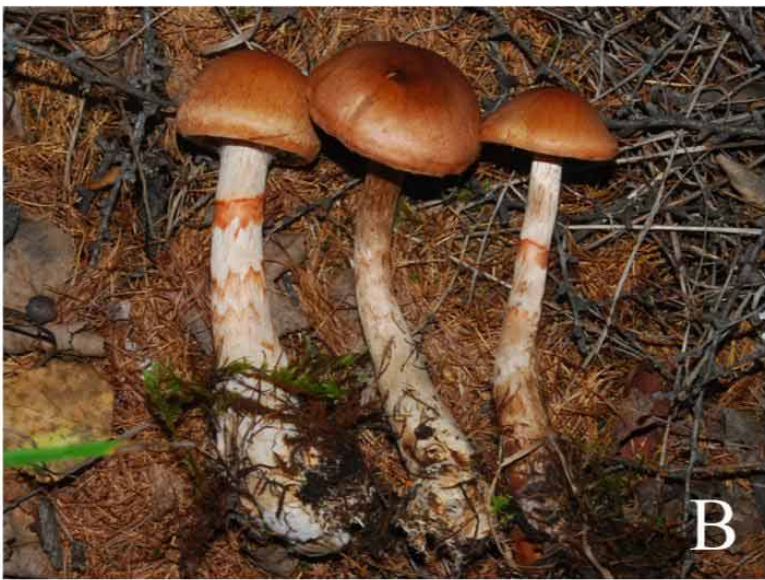
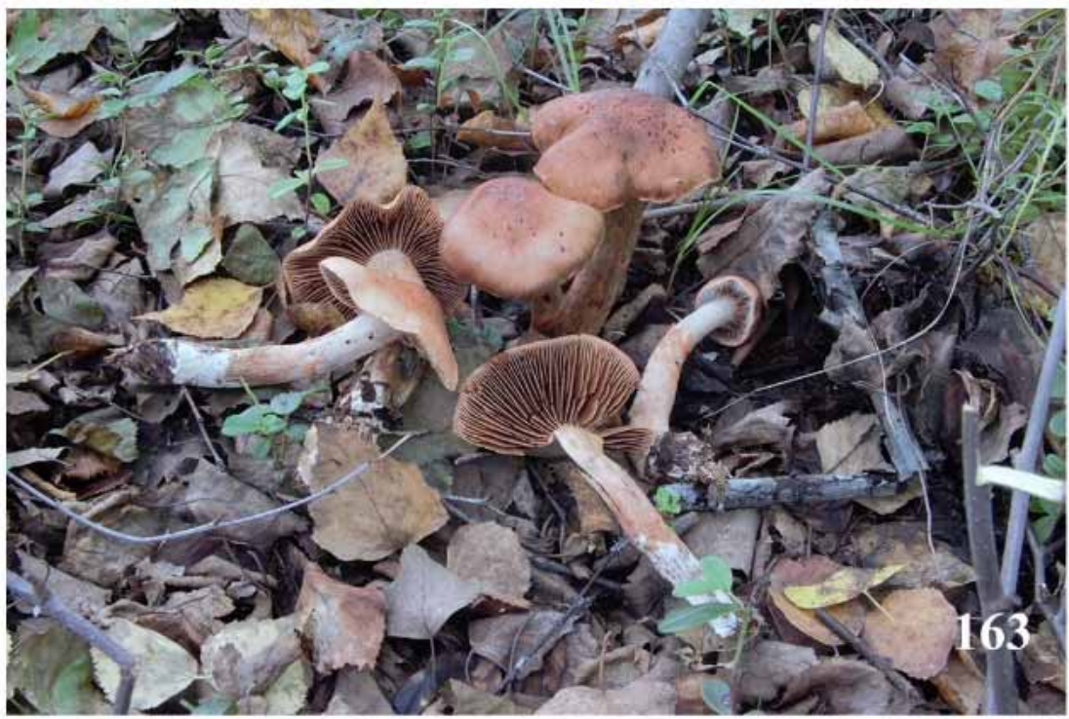
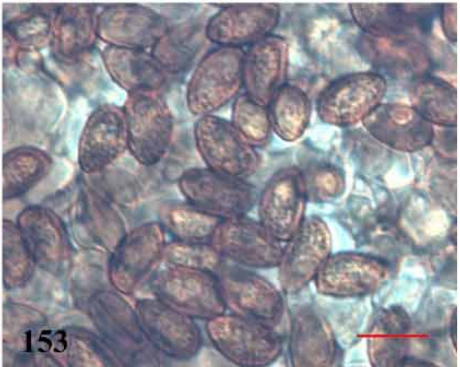
Cortinarius armillatus (Fr.: Fr.) Fr., Epicr. Syst. Mycol. 295 (1838). Figs. 2A, 3A, 4–7
Basionym. Agaricus armillatus Fr., Observ. Mycol. 2:61 (1818); sanctioned in Fr., Syst. Mycol. 1:214 (1821). Type: SWEDEN. ÅNGERMANLAND: Såbrå, Furuhultsån 2 km N Innerbrån, in wet coniferous forest with blueberries (Picea, Betula), 23 Aug 1987, Lindström et al. CFP584 (S, NEOTYPE, neotypus hic designatus). GenBank DQ114744.
Cortinarius armillatus var. miniatus Reumaux, Atlas des Cortinaires 7:227 (1995). Type: FRANCE. ARDENNES: La Croix aux Bois, under Betula, 200 m, 2 Oct 1985, P. Reumaux 3127 (G, HOLOTYPE). GenBank HQ845115.
Cortinarius armillatus var. subcroceifolius Bidaud, Moënne-Locc. & Reumaux, Atlas des Cortinaires 7:228 (1995). Type: FRANCE. ARDENNES: Forêt de Belval, under Carpinus betulus, 200 m, 20 Sep 1992, P. Reumaux 3135 (G, HOLOTYPE). GenBank HQ845116.
HQ845116. Cortinarius haematochelis sensu Bidaud, Moënne-Locc. & Reumaux, Atlas des Cortinaires 7: fiche 265 (1995).
Illustrations. Bidaud et al. (1995: pl. 146, 147), Brandrud et al. (1992: pl. B09), Consiglio et al. (2004: pl. B17), Fries (1867–1884: pl. 158).
Pileus. 5–11 cm, convex with an incurved margin when young, later plano-convex with a low, broad umbo; surface often has distinct, small red scales especially at the center, finely innately fibrillose toward the edge, often with orange-red patches or coating of veil in the margin, yellowish red-brown to yellow-brown, often somewhat paler toward the edge; only somewhat hygrophanous, with fine, dark hygrophanous streaks.
Lamellae: medium-spaced (45–65 reaching the stipe), emarginate, medium thick to thick, light brown when young, dark brown with age; edge somewhat lighter, rather uneven.
Stipe: 7–17 (–20) × 0.8–1.5 cm (top), cylindrical, clavate at base (–3.0 cm) rarely wholly cylindrical, white fibrillose when young, later grayish brown. Basal mycelium: white to pale pinkish. Universal veil on stipe: vivid orange-red, usually forming an annular band on the middle part and distinct belts or zones lower down.
Context: marbled with gray brown to brown when fresh and moist, becoming whitish brown with loss of moisture, darker toward the base of the stipe. Odor: in lamellae slightly raphanoid. Exsiccata: pileus red-brown to dark brown to sometimes blackish brown; stipe grayish to grayish brown; red universal veil still visible on the stipe; basal mycelium white or pinkish. Chemical reactions: KOH on universal veil on stipe purple.
Spores. 9.7–10.8–11.8 × 5.9–6.3–7.0 µm, Q = (1.53–)1.58–1.71–1.79(–1.87), Qav. = 1.65–1.78 (320 spores, 16 collections, Figs. 3A, 4), weakly sigmoid to narrowly amygdaloid to narrowly ellipsoid, sometimes with a low suprahilar depression slightly curved apex to the abaxial side of the spore, making the spores unique; thick-walled, fairly finely to moderately, densely verrucose, most strongly at the apex; warts somewhat anastomosing, strongly dextrinoid, at least some spores becoming brownish red in KOH, but this character was not observed in all specimens. Spores on the lamellae usually less dextrinoid and slightly narrower. Lamellar trama hyphae: in the overall view (pale) olivaceous yellowish to olivaceous brownish in MLZ and KOH, smooth to distinctly finely scabrous, with small to large, olivaceous brown spot-like incrustations. Basidia four-spored, 30–35–41 × 8–8.5–10 µm, av. 33–40 × 7.6–9.4 µm (100 basidia, 10 collections), with pale yellowish to olivaceous brownish contents in MLZ and KOH. Lamellar edge fertile with basidia and narrowly clavate cells. Pileipellis (FIG. 5): Epicutis medium thick; uppermost hyphae 4–10 µm wide, yellowish brown to olivaceous yellowish brown in MLZ and KOH, smooth (to very finely scabrous); lower hyphae 6–12 µm wide, almost hyaline, smooth to finely scabrous. Hypoderm weakly developed with elongated elements about 40–75(–90) × 17–25 µm, almost hyaline, fairly thin-walled, smooth to finely encrusted. Hyphae in the transition to trama smooth to finely encrusted in KOH, in MLZ with scanty, small, pale olivaceous brownish, spot-like incrustations. Clamp connections: present.
ITS regions (including 5.8S region). 514–515 bases long (based on a total of seven sequences, including sequences from three type specimens). Sequences from the type material of C. armillatus var. miniatus and C. armillatus var. subcroceifolius were identical to the neotype sequence. The other four sequences have one indel and two intragenomic length polymorphisms, but we found no morphological or ecological characteristics to support the groups. Cortinarius armillatus differs from all other Armillati species by more than 20 evolutionary events. Sequences retrieved from the public databases (a total of 10): Six of them were from Nordic countries (AJ236075, UDB002174, AM902009, AM999568, AY839212, AY839206), one from British Columbia, Canada, (EF218759) and no locality was mentioned for two (AY669671, AF037223). The intraspecific variation in the sequences is much higher than in our own sequences (0–7 evolutionary events), despite most also being from Nordic countries. Some differences are probably reading errors, such as AY839206 from Sweden that differs by seven evolutionary events. Most of the differences in this sequence are indels at the end of the ITS 2 region, and they are double bases instead of one. A common phenomenon is that at the end of the sequence signal quality is poor and peaks start to get tails that sometimes are read as separate bases. Therefore chromatograms should be examined to confirm the differences. One sequence from North America (DQ367895) however differs so much (14 evolutionary events) that it could be a separate species from C. armillatus, but further studies are needed. One peculiar thing in the sequences retrieved from the public databases is their source. One of them is from house dust and one from bryophytes, which has to be a consequence of C. armillatus’s abundant fruiting.
Ecology and distribution. Cortinarius armillatus grows in deciduous and mixed forests with Betula, possibly also with Carpinus, on damp to fairly dry, usually oligotrophic soil. It also is common in coniferous forests under solitary birches and in manmade habitats such as yards, parks, cemeteries and roadsides. It grows in loose groups and often is abundant. It is one of the most common and abundant Cortinarius species in northern Europe. Fruit bodies occur late Jul–mid-Oct, but the peak of the fruiting season is often from mid- to late Aug (FIG. 6). Cortinarius armillatus is common in hemiboreal to subarctic zones and rare to occasional in the temperate zone (FIG. 7). The species is known in Europe and North America.
Differential diagnosis. Cortinarius armillatus is the easiest species to identify in the group. Typical for the species are the vivid orange-red universal veil, which usually forms distinct belts or zones on the stipe, fairly large, thick-walled, strongly dextrinoid spores and habitats with Betula. The pileus also is typical with small red scales, especially at the center. All the other Armillati species have less pronounced, pinkish to vinaceous red, rarely yellowish brown to pink brown universal veils and smaller and/or less dextrinoid and/or thin-walled spores. C. luteo-ornatus and C. pinigaudis sometimes can have almost C. armillatus-like bands of the universal veil on the stipe.
The description of C. armillatus by Fries (1821) “pileo squamuloso testaceo-rubro ... stipite bulboso, velo contexto rubro” and the fruiting bodies illustrated in Fries (1867–1884: pl. 158) fit our species well. The collection Lindström et al. CFP584 (Brandrud et al. 1992: pl. B09) represents a typical C. armillatus, and we propose it as a neotype for the species.
Two varieties of C. armillatus were described in Bidaud et al. (1995): Cortinarius armillatus var. miniatus Reumaux and C. armillatus var. subcroceifolius Bidaud, Moënne-Locc. & Reumaux. Cortinarius armillatus var. miniatus is a brilliant variety of Cortinarius armillatus with a minium red pileus and universal veil. The type material is collected under Betula. The exsiccatum is similar to those of C. armillatus and the spores (9.8–10.2–10.6[–11.2] × [5.6–]5.9–6.1–6.4 µm, Q = [1.56–]1.60–1.67–1.75 [20 spores]) fit our material well. Cortinarius armillatus var. subcroceifolius is, according to the authors, a slender variety of Cortinarius armillatus, which grows under Carpinus betulus instead of Betula. The exsiccatum and the spores are C. armillatus-like ([10.1–]10.3–10.7–11.2[–11.7] × [5.9–]6.1–6.3–6.4 [–6.9] µm, Q = [1.60–]1.63–1.69–1.78 [20 spores]). In both types the ITS regions are identical to those of the neotype of C. armillatus. Based on the morphological, ecological and molecular data, we conclude that Cortinarius armillatus var. miniatus and C. armillatus var. subcroceifolius essentially do not differ from C. armillatus and should be considered synonyms of the latter. Cortinarius haematochelis sensu Bidaud, Moënne-Locc. & Reumaux (1995) most likely represents C. armillatus. The figure is C. armillatus like and the spores are almost similar in size. For more about C. haematochelis see C. paragaudis.
Specimens examined (a total of 565 collections, for the complete list of specimens see SUPPLEMENTARY TABLE II). SWEDEN. ÅNGERMANLAND: Såbrå, Furuhultsån 2 km N Innerbrån, 23 Aug 1987, H. Lindström et al. CFP584 (S, NEOTYPE), GenBank DQ114744. FINLAND. POHJOIS-HÄME: Uurainen, Kutula, 5 Aug 1995, I.K. 95-117 (H, TUR), GenBank HQ845111. KOILLISMAA: Kuusamo, Oulanka, Puukkorinne, 26 Aug 2002, K.L. & T.N. 02-091 (H), GenBank HQ845112. PERÄ-POHJANMAA: Rovaniemi, Pisavaara, 31 Aug 2004, K.L. & T.N. 04-581 (H), GenBank HQ845113. INARI LAPPI: Inari, N side of Lutto River, 14 Aug 1995, I.K. 95-395 (H, TUR), GenBank HQ845114. FRANCE. ARDENNES: Forêt de Belval, 20 Sep 1992, P. Reumaux 3135 (G, HOLOTYPE of C. armillatus var. subcroceifolius), GenBank HQ845116. La Croix aux Bois, 2 Oct 1985, P. Reumaux 3127 (G, HOLOTYPE of C. armillatus var. miniatus), GenBank HQ845115.


.jpg)
.jpg)